
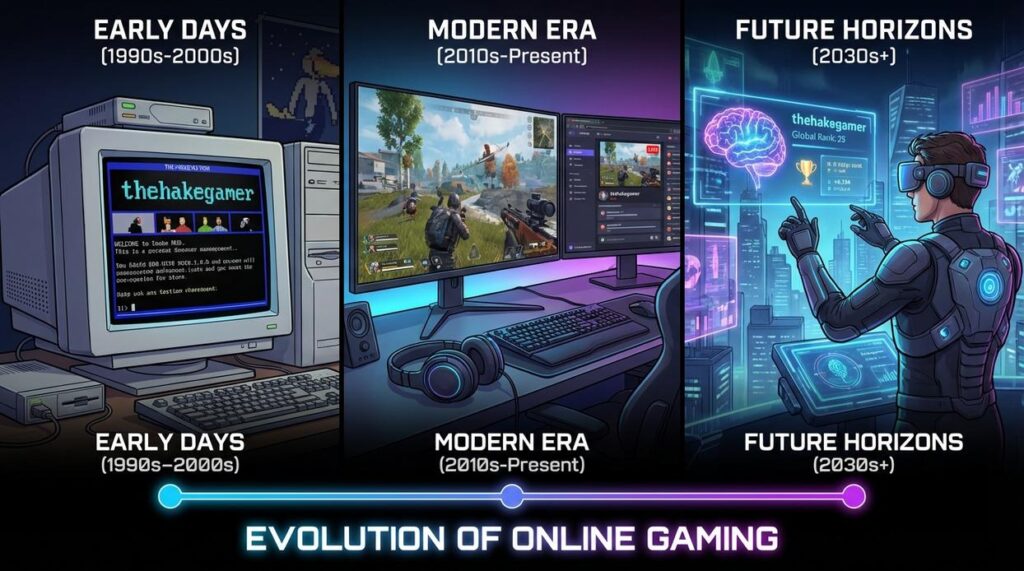
I’ve been gaming online since you had to explain to your parents why the phone line needed to stay open for “just one more match.”
You’re probably here because you want to understand how online gaming has evolved thehakegamer from those early days to what we have now. The story is bigger than you think.
Here’s what happened: we went from typing commands in text-based MUDs to dropping into massive battle royales with 100 players. And it didn’t happen overnight.
I spent years playing through each major shift in online gaming. I configured dial-up modems for Quake matches. I waited through painful load times. I watched entire genres get born and die.
This article walks you through the real history. Not the sanitized version. The one that includes the tech struggles, the cultural moments, and the games that changed everything.
I’ve been there for every major era. From the first time I connected to another player over a phone line to competing at levels that demand split-second precision today.
You’ll see how technology pushed gaming forward, which titles actually mattered, and why certain moments became turning points that shaped what you’re playing right now.
No nostalgia trip. Just the chronological breakdown of how we got from there to here.
The Genesis: Dial-Up, LANs, and the First Pioneers (1980s-1990s)
I’ll be honest with you.
Most people have no idea how brutal online gaming used to be.
They think lag is bad now? Try waiting three seconds for your character to swing a sword because someone in your house picked up the phone.
The early days weren’t pretty. But they mattered.
Before Fortnite and Warzone, we had MUDs. Multi-User Dungeons were pure text. No graphics. Just words on a screen and your imagination filling in the gaps. You’d connect through ARPANET (yeah, the internet’s grandparent) and type commands like “attack goblin” or “go north.”
Sounds boring, right?
Wrong. Those text-based worlds hooked people for hours. They proved something important. People wanted to play together, even when the tech barely worked.
Then came the LAN parties.
If you never lugged a desktop tower and CRT monitor to a friend’s basement, you missed out. We’d spend half the night just getting the network to work. The other half? Pure chaos in Doom and Quake deathmatches.
That’s where competitive gaming was born. Not in some fancy arena. In someone’s garage with pizza boxes everywhere and cables tangled like Christmas lights.
But dial-up? That was the real enemy.
Every minute online cost money. Your mom would yell at you for tying up the phone line. And that modem sound (you know the one) became the anthem of patience. Games had to work around these limits, which is why turn-based strategy thrived while real-time action struggled.
Then Ultima Online and EverQuest showed up and changed everything.
These weren’t just games. They were persistent worlds that existed whether you logged in or not. Other players were building, fighting, and trading while you slept. That concept blew minds in the late ’90s.
Looking back at how online gaming has evolved Thehakegamer community still talks about these foundations. Because without those early pioneers dealing with terrible tech and expensive phone bills, we wouldn’t have what we have today.
The graphics were rough. The connections were worse.
But the community? That part was already perfect.
The Broadband & MMO Revolution (Early 2000s)
Remember dial-up?
You’d hear that screech, wait three minutes to connect, and pray nobody picked up the phone while you were playing.
Then broadband showed up and changed everything overnight.
Broadband Changes Everything
Always-on internet wasn’t just faster. It fundamentally rewired what games could do.
Suddenly developers could build worlds that didn’t kick you out every time your mom needed the phone. You could have hundreds of players in the same space without everything grinding to a halt.
The difference was night and day. Dial-up gave you maybe 56 kbps on a good day. Broadband? You were looking at 1 Mbps or more. That’s not an upgrade. That’s a different universe.
The World of Warcraft Phenomenon
Some people say WoW was just another MMO that got lucky with timing.
They’re wrong.
World of Warcraft didn’t just dominate the market in 2004. It showed millions of people what online gaming could be. Before WoW, MMOs were for hardcore players who had time to figure out obtuse interfaces and confusing quest systems.
WoW made it accessible. You could log in, understand what to do in five minutes, and actually have fun.
The raid system? That became the blueprint. Structured guilds with ranks and responsibilities? Standard now. The idea that you could build a social life inside a game world? WoW proved it at scale (12 million subscribers at its peak).
Rise of Console Online This is something I break down further in Why Gaming Is Good for You Thehakegamer.
But here’s what the PC crowd often forgets.
While WoW was conquering desktops, consoles were figuring out online play in the living room. Xbox Live launched in 2002 and did something nobody had done well before. It standardized everything.
One friends list. One matchmaking system. Voice chat that actually worked.
Halo 2 in 2004 showed what that meant. You could jump into a match with people across the country in seconds. No server browsers. No complicated setup.
PlayStation Network came later but brought the same idea to Sony’s audience. The comparison was clear: PC gaming gave you flexibility and complexity while console online gave you simplicity and consistency.
Different approaches. Both worked.
Community Takes Root
This is when how online gaming has evolved thehakegamer really started to show.
Forums exploded. Sites like Elitist Jerks and Thottbot became required reading if you wanted to play at a high level. People were writing 10,000-word guides on optimal talent builds.
Theory-crafting went from a niche hobby to something millions of players cared about. You weren’t just playing anymore. You were studying, discussing, and arguing about the best strategies with people you’d never meet in person.
The game became the starting point. The community became the reason you stayed.
The Social & Competitive Era (Late 2000s – 2010s)

Something changed in gaming around 2008.
It wasn’t just about playing anymore. It was about watching, competing, and building entire careers around games.
I remember when people laughed at the idea of professional gamers. Now? Some of them make more than traditional athletes.
The Birth of Esports
StarCraft II launched in 2010 and South Korea went wild. But the real shift happened when League of Legends and Dota 2 turned competitive gaming into a global phenomenon.
We’re talking sold-out arenas. Prize pools in the millions. Sponsorships from companies that had never touched gaming before.
The International (Dota 2’s championship) hit a $1.6 million prize pool in 2011. By 2019, it crossed $34 million. That’s not a typo.
The Power of Modding
Here’s where things get interesting.
Defense of the Ancients started as a Warcraft III mod. Just fans tweaking Blizzard’s game in their spare time. That mod became the blueprint for an entire genre (MOBAs) worth billions today.
| Original Mod | Year Created | What It Became |
|---|---|---|
| Defense of the Ancients | 2003 | League of Legends, Dota 2, Heroes of the Storm |
| Counter-Strike | 1999 | CS:GO, Valorant influence |
| DayZ | 2012 | Battle royale genre foundation |
Community creators weren’t just playing games. They were inventing new ways to play that developers hadn’t imagined.
Social Integration and Streaming
Then Twitch showed up in 2011.
Suddenly you could watch someone play live. Chat with thousands of other viewers. Learn strategies in real time.
YouTube gaming channels exploded too. PewDiePie hit 1 million subscribers in 2012 playing horror games and doing commentary. By 2013, he had 10 million.
Gaming went from something you did alone in your room to a shared experience. You could make friends across continents based on game tips thehakegamer communities shared.
Some streamers now pull six figures just from subscriptions and donations. It became a legitimate career path (though not an easy one).
Pro Setups and Optimization
Competitive players started obsessing over every detail. This connects directly to what I discuss in Thehakegamer Best Gaming Updates by Thehake.
A regular mouse wasn’t good enough anymore. You needed one with the right DPI, the perfect weight, programmable buttons. Same with keyboards (mechanical switches became the standard) and monitors (144Hz refresh rates instead of 60Hz).
The difference between winning and losing a match often came down to milliseconds. That’s how online gaming has evolved thehakegamer culture from casual play to serious competition.
Companies like Razer, Logitech, and SteelSeries built entire product lines around this demand. Gaming peripherals became a multi-billion dollar industry.
Even casual players started upgrading. Because once you try a 144Hz monitor, going back to 60Hz feels like playing in slow motion.
The Modern Landscape: Live Services, Cross-Play, and Niche Communities
Gaming isn’t what it used to be.
You buy a game, you play it, you move on. That’s how it worked for decades.
Not anymore.
Games as a Service changed everything. Look at Fortnite or Apex Legends. These aren’t just games you finish. They’re platforms that get new content every few weeks. New seasons. Battle passes. Limited-time events that keep you coming back.
Some purists hate this model. They say it’s just a cash grab. That developers are nickel-and-diming players with endless microtransactions instead of making complete games.
I hear that argument a lot.
But here’s what they’re missing. The live service model means games actually get better over time. Developers fix bugs, balance weapons, add features players ask for. Compare that to the old days when you were stuck with whatever shipped on the disc (bugs and all).
Cross-play broke down the biggest barrier in gaming. For years, if your friend had an Xbox and you had a PlayStation, tough luck. You couldn’t play together.
The technical challenges were real. Different network infrastructures, different update schedules, different controller inputs. But the political stuff? That was worse. Console makers wanted to keep players locked into their ecosystems.
Then something shifted. Players demanded it loud enough that companies had to listen. Now I can squad up with friends on PC while they’re on console. The player base stays healthy because we’re not split into tiny fragments.
The depth of modern gaming communities is wild. How online gaming has evolved thehakegamer shows us that people don’t just play games anymore. They transform them into something entirely new.
Take hake-focused modding. Yeah, you read that right. There are communities dedicated to modding games to feature hake fish. It sounds absurd until you realize it represents something bigger. People can find their exact niche and build around it.
That’s the beauty of new video games thehakegamer covers. The options are endless.
Cloud gaming and the metaverse are next. Services like Xbox Cloud Gaming let you play AAA titles on your phone. No console needed. The metaverse concept promises persistent worlds where your identity and items carry across different games.
Will it work? I’m skeptical about some of the hype. But the technology is moving whether we’re ready or not.
The Ever-Expanding Digital Playground
We’ve covered a lot of ground here.
From simple text commands to massive worlds where millions of players connect at once. How online gaming has evolved thehakegamer shows us that technology and community have always been the driving forces.
This history isn’t just about better graphics or faster servers. It’s about connection. First through a phone line that tied up your house line for hours. Then through dedicated servers. Now through global communities that span every timezone.
The core principles haven’t changed though.
Innovation pushes boundaries. Competition raises the bar. Community keeps people coming back.
The next era is already taking shape. You can see it in niche modding forums where creators are testing wild ideas. You can see it in cloud data centers that are rewriting what’s possible.
Here’s what I want to know: What was your first online gaming memory?
Maybe it was dial-up lag in your first match. Maybe it was joining a guild that became like family. Whatever it was, those moments shaped this journey for all of us.
Join the conversation and share your story. The history of online gaming isn’t just dates and tech specs. It’s the memories we made along the way.
 Timothy Speronzo played a pivotal role in the technical architecture of The Hake Gamer, ensuring the platform could support its complex range of modding resources and community features. His contributions to the project's foundation allowed for a seamless integration of high-performance data and user-focused tools. By bridging the gap between sophisticated backend design and the needs of a growing gaming community, Speronzo helped turn the initial concept into a robust, functional reality.